6.9.13

Authenticity: In two forms of afunctional signs


The two forms of afunctional signs, here the specific and literal object indicating direction, place, service or content of a location, are such: first, the absence of referent. A sign looms over a demolished Café, it reads cafe, it calls to them looking for a cup of coffee, the cafe is gone, missing. The second: superfluity of the sign. A local shop or restaurant, in a place small enough to have need, capacity and interest for a single shop or restaurant, but which still undergoes a logo, a description, a slogan, a name, but which would be equally prosperous, for being pure necessity, with a different sign and logo. The first, the absent referent of the absent cafe, is contrasted with an active referent, like the grammar of motel signs, granting to ignorant travellers the location and quality, full or no, wifi or no, hbo or no, motel-style or hotel-style. The second, superfluous small town restaurant, is contrasted with graphic design branding logo bullshit. This latter contrast isn't a question of the active capacity for signs to indicate, or the intention behind any indication. It's probable some primitive branding occurs in a superfluous sign or less intensively thought out image, and it's also probable that branding is a stupid behavior that does little to justify its expense or its aesthetic desertification. The contrast is instead how the practice of brand or sign is entwined in the one; a shitty soap store is essentially a shitty soap and image store, while a cafe without another for a hundred miles is a cafe, the sign being nothing to speak of.

The prime sign discussed here is the afunctional superfluous. The absent referent refers instead to a present absence; the sign is ironic or frustrating or quaint or sad, it speaks to the former presence and current absence, a decline of some sort, but it can't reach the point of an active engagement while being itself so lacking. The active referent sign is the place for basic grammar and syntax, work I am not fit to speak on intelligently. The branded signifier is distasteful and undignified, it is beneath any human being to talk about, and yet, they do. Barring those three, it is the afunctional superfluous that marks the sign and then encounter of the properly authentic sign-undergoing.

There is and should be a bubbling hesitation here, and whenever conceptual authenticity is invoked. It is a dangerous premise, either hierararchically, this practice is, in itself, better without reference to conditions or aspects, or as a conceptual boundary, this is because it is appropriate to itself and nothing else. Critiques of authenticity are usually some variety of empiricist, pointing out all the ways a thing is not appropriate or even identical to itself, or how this moral mystification of the higher fails to elaborate itself, taking itself as a kind of authentic or appropriate quality itself, so authenticity is the authentic way of things to be instead of itself interrogated (what if authenticity is an ugly and pathetic way to be, for instance). The former argument tends toward a Foucauldean faux-humility; "There may be an essence or truth somewhere but it isn't here", a rhetorical defense mechanism to avoid the problems of actively undertaking anti-essentialism, and effectively caches the old thin metaphysical authenticity by marking it the standard for a concept's self-identity. In order to then describe the strange existence of a thing that appears authentic or self-identical, contrary authenticities are proposed, distribution, problematization, (deferred) relation, etc., but still a practice of being-authentic even if the literal and reductive authenticity of a previous era is criticized. Authenticity here is a ghost but is a sign like the demolished cafe, an absent and structuring presence. The latter, on the assumption of authenticity's value, makes its point well, in that authenticity is too cheaply done when it is, but abandoning it to the unreconstructed and paleo-thomists more ensures the authenticity discussed is the stupid rather than potentially other kind.

Instead, a definition of authenticity should be only of the functionalist variety, a description of that which exists in the recognition and understanding, where it exists, of a thing as authentic. It should further be unbound from self-identity; an authenticity is a strain characterizing the structure of relation. It obviously doesn't inhere in objects, taking a sign from the front of a store and putting it in an antique shop changes what thing it is. But neither does it inhere in the relations themselves, it is an outcome and the understanding of authenticity is an aesthetic one; how is authenticity achieved and that achievement is the nature or essence of authenticity as an aspect of a thing separate from authenticity itself. These are not abstract or prior conditions to be satisfied, but features of practical authenticity. This latter, this practical authenticity, is an effect of the afunctioning sign itself. Consider the null sign, pointing to an absence, then the ugly sign of a contemporary shop, that exists and is referential. The latter conveys a series of purposes; this shop is clean, nice, shitty people, the kind of people you like, they come here, you'll like it, this shop is here and not elsewhere. The former only effectively conveys its own being, that it is, and is a sign, and is non-referential. What it does (says), and what it is, are severely identical. Now consider the other opposed cross-pair, the designed shopfront and the could-be-otherwise shopfront. It could suggest to some eye that it is the selling that is inauthentic, but that's a very limited description of a chain of effects. Instead, put it this way. The shop that begs, in design, for customers, is making itself be as its audience. It is in the way the people it wants to come are, it is the same or looks to be the same as them. The other kind of shop sets up, however, a minimal chasm, a so-called otherness, by having its existence entirely (or to the degree that it is) untied to your attractions. It speaks nothing to you, or nothing in particular, because the nothing it speaks is how much it needs to. The shop sells the thing you need, and its very far to get another one and more expensive, so you buy the thing you need at the shop, regardless of if the sign is inviting or the slogan makes you feel the void that people who are inclined to enjoy slogans enjoy to feel, the sign outside of that shop is not being-sign but not-being-sign, being an empty signifier such that the structure of a restaurant would be incomplete without it (and would compose itself a further and active sign, a signless restaurant being creepy or psuedist modern, depending on how urban or rural the environment). The lie of "otherness", in every and all vulgar identity schemes, is the lie of the first kind of shop sign, that communication is between two sames and distinction is between two others. But the truth, here of authenticity, is that the communication between sames is absent and so is distinction, while between difference, and not other, between difference, there is communication and a being-with which is absent any other way.

To put this last point in less abstract terms: some fucking bonehead drives his car down the street and sees a sign for a shop, the sign is designed, it spells out, in the shop, he will find the things the man he strives to be strives to buy, and if he goes, he buys the things, he does the striving necessary for him the buyer to be him the be-r. The buying he does isn't the thing to be done, because the buying is too specific; how to make a thing for each such bonehead, impossible, the striving is all that is needed and the striving is made by the sign and the logos and shit all plastered over the shop. He, the fucking bonehead, is only such that he goes into places where he already knows what they are, places with full and complete signs, signs that mainly indicate that he has been in one or this one before so that he can never be caught off guard and end up getting the wrong coffee style or whatever haunts his particular vapid soul. In this is only the absence of encounter, the mingle of thousands of necessities and attractions, neither thing so stark in its being that there can congeal a being-together between them, this is about microtransactions that build to a head, and to a purchase. Change the shop, the man feels off-put, change the man, he falls from the demographic conception of a customer anyhow; these are two things that lack the necessity of strict identity because they are more adequately understood as a continuum of the same process. Now, the second kind, some person makes for a shop, they need some coffee, same as the first one, but they find no comforting same-signs, no proofs of corporate uniformity or brand consistency, they go in a shop and have to get what the shop sells, have to drink what the shop makes, their own desires then limited. They might get some gross coffee, or strange beans on their gravy and biscuits or they might get sick with polluted water, but the absence of their necessity to the functioning of the object, and the object's manifest indifference toward the man as object, leaves not otherness and estrangement but conjunction and interaction, both enduring individual identity for the single moment necessary to form a way of being in which both are to each and become other than their identities for the period of their being-together.

This is why the response to the afunctioning sign is that of authenticity and not truth or some other similarly shaded absolute concept. The absent referent (being qua) and the superfluous sign (being-with) both intensively produce being as the primary, or at least loudest, nature of their sign. As it does so, both suggest the distinction of a faltering, a miscommunication (the sort of which communication is structurally necessitated by), a gap, and as a gap, an identity, and as an identity, a something to be conflated-with another something. By not functioning, overtly, and by persisting, overtly, the need to explain the latter in light of the former means that the being of the object is its primary character, that there is identity between the thing-itself and the way it is-itself, and that this identity is placed in difference rather than same. The afunctional sign is a sign as such because it needs something, if afunction, to be.

This, to be clear, is not to claim anything more for signs and authenticities than has been established here. They are not real concepts and don't establish necessary hierarchies, even if contingent ones do exist (i.e. fuck your shitty brand and your shitty brand life, it is worse and so are you). The danger of ignoring their continued functioning is that it repeat the structure of authenticity (and word and being, etc.); absence is granted power because of itself as absence, truth becomes metaphysical, the thing that isn't, is able to become more than the thing that is. Instead, authenticity as practical needs to be acknowledged and its functioning as an aesthetic aspect needs to be further elaborated on.

25.7.13

Birthday Pig


Which pig,
he did die first, which pig,
he did die before the other,
which pig, he left alone for
his long minute, which pig
was it for, to die second.

The oldest pig, he did die
first, being the oldest his
lungs and guts were holding
longer than life had held,
he carried on with him the
smell or sense of death had
happened, it only hadn't
finished on him yet, one
dozen or two dozen year
fall out a window, the
oldest pig, he was the one
to die before the younger,
the one shaded harder blue,
the one so shaded make it
hard to look at him, blue
from freezing or suffocate
from inside, turned lungs.

But younger pig and older
pig were now to make the
same shades, minutes of
looking on them held in
touch, too late, for which
is first means both are
dead, both pigs are blue,
too late for older, for
younger, these are pigs
are blue and going more.

15.3.13

happy ides, AA

1.3.13

Has Mat Fun

21.2.13

PATCH


                             Gobbling ugly mouth, lips like burst slugs,
                              he pointed to the patch on his shoulder and        
                                        said, "Sorry fellow. That's classified. Hee hee hee."


//////////////////////////////////////////////////////////////////////////////////////

—The man, he's the radio for the team, he lets off, through his normal heartbeat and other emissions, the team's location and basic health. Humans are also very emotionally intuitive, he will broadcast the emotions and stress of the team every time he empathizes with the dog or the boar. He wears a brown suit and a cap with an antenna on it, the antenna has nodes that attach to his skull and neck.

—The dog is the chief navigator, ready to explore, to scout, with his swift legs, or to use his keen eyes and nose to decipher the route forward. He is normally quite reserved but before they left, the compound, he volunteered, in a tearful private speech, to risk any danger that the mission be a success. He is white and russet and dark brown, he looks like an old potato going rotten under the sink.

—The boar or warthog is the muscle and the conservative, who will keep discipline among the varied members as well as keep them from exploring / adventuring needlessly. He is a hard boar, hard of soul, of hair, of noggin, of personality, just hard throughout. He is black and his fur is so coarse that it hurts to pet him. That's just the way he likes it, though.

—The snake is the genius and the scientist for the mission. Any specimens will be stored inside of its enormous digestive apparatus and analyzed later at the laboratories. More than the others, it is difficult to control because he escapes so quickly and easily, and can curl up into tight places that none of the other team members can fit within; this is also one of his greatest strengths, because there will be plenty of tight squeezes in the next few days. Nobody knows if it is a boy or a girl. It is pretty much green.

\\\\\\\\\\\\\\\\\\\\\\\\\\\\\\\\\\\\\\\\\\\\\\\\\\\\\\\\\\\\\\\\\\\\\\\\\\\\\\\\\\\\\\

The end of her wing, she beats they chatter the dry jaw
her hooked foot
through the open peak
one hooked nail
held on a notch

too big a prize and there I fucked it and lost is
another name for pleasure

the end of her wing
beats barely flying home
thumbs in the small notches
between the teeth


//////////////////////////////////////////////////////////////////////////////////////


The cat creeps through some bad grass.

Bad, brown grass grows out of the sand on an airforce base.

\\\\\\\\\\\\\\\\\\\\\\\\\\\\\\\\\\\\\\\\\\\\\\\\\\\\\\\\\\\\\\\\\\\\\\\\\\\\\\\\\\\\\\

What I have to tell you is un-complicated. Please look at my face while I explain. Do you wonder who is speaking? Look at my face. Behind my face, my wings are heaving, no? What I have to say is not complicated. You need to pay attention to this:

L I V I N G I N T H E C O N T E M P O R A R Y I S B O R I N G Y O U A R E A L L B O R I N G Y O U D O N T D O A N Y T H I N G

////////////////////////////////////////////////////////////////////////////////////////

“remember acronyms, initialisms
come into widespread english use
through the us army and the us army
empire.” 
I didn’t say acronyms, initialisms
are wrong, no or that origin is
their meaning, didn’t that either,
I am going to use shame to keep
you from something ugly, and what
I can’t do, no power to, is
gesture barely enough, you notice.

\\\\\\\\\\\\\\\\\\\\\\\\\\\\\\\\\\\\\\\\\\\\\\\\\\\\\\\\\\\\\\\\\\\\\\\\\\\\\\\\\\\\\\

What is distinct about the American, is that he flies so carefully. He expresses his rule-bound character, he does not think that the plane will fly if he sins against the airplane manual! But, it is important to know that he makes his planes in this way, with himself in mind. You or I take control of the plane, we will plummet! We will risk for an instant, we will forget only one button, we will plummet! This is another example of how ideology reproduces itself within you.


//////////////////////////////////////////////////////////////////////////////////////


First one, then another breeze, passed Rodeo Gal.
It thundered and when it thunders from below,
the air presses upward and Rodeo and Martell
the whale feel the press, up like a bloom, and densities shift.

Since seven years, she has ridden here, without
stopping once back on earth, since seven years,
she has rode and flown on the back of Martell, since
seven years, she and that whale Martell were
modified, to be made fit to fly in the air,
since seven years and still she can feel her brain
become unsettled at the disturbance in the air,
she watches as it will coast through explanatory 
emotions, since seven years, rode and flown, never 
stopping to the ground, still the explanations are are 
all inhabited, wrongly to some earth circumstance, 
and today, she is set on by two breezes and a blast 
of thunder from south texas, she has to blink and 
grind her hands into the reins, as she is being 
frustrated about her party, busting up by local 
police, she is going to have to afford an attorney, 
for some bullshit about underage drinking and 
some marijuana, she should have known better 
than to keep around, her hand grinds the rein, to 
ride it out, and Martell screams, having himself his 
own frustrations, he carelessly bucks, and Rodeo
ties on, to the rise of the bloom beneath.

\\\\\\\\\\\\\\\\\\\\\\\\\\\\\\\\\\\\\\\\\\\\\\\\\\\\\\\\\\\\\\\\\\\\\\\\\\\\\\\\\\\\\\

horns or eyes or horns are eyes
penetration always
and our banner
my friends your eyes
red and black and white
blood and nothing and nothing
nothing but blood and force

(by bernard)


14.2.13

Someone Shit in the Urinal: A Diagram of Pleasure against Unpleasure, Social Failure against Social Disruption, and Capacity against Incapacity

Reviews of Puns using the Seoul / Soul Pseudo-Homonymy

These assorted puns all use, in some way, the movement between the word Seoul, meaning the city in Korea, and Soul, the spiritual or essential concept. I have collected and arranged the following, with short to medium reviews of whether the pun, in the context of the visual image as it occurs, is good or not.

This pun is bad. "The Seoul" is not coherent to refer to the city, so it becomes lopsided toward "soul". It appears to be a pun based only on the pseudo-homonym. 


This pun is not very good. While it has a semi-layered meaning (you are not just buying the nice exterior[ity] but the high-quality asian interior[ity]), there is no such phrase that I'm aware of "buy it body and soul". What would it mean to buy something body and soul, except as it regards, uncomfortably, male fantasies of prostitution, which seem incorrectly juxtaposed with this car.


This is not exactly a pun, but a resonance, and it is not very good because the rhythm of the specific line is not very good. If you're going to have that symmetry of "soul in Seoul", the preceding and proceeding lines should have a relation, instead of "my black American" and "South Korea" otherwise the reader will insinuate that you have racialized and othered the nature of "South Korea" with a vagueness that stands in contrast to your specificities. The cover is very good and the topic seems also very good, despite the poor resonance. 


This pun is terrible. First, Seoul in the image is very bright, it is not dark at all. Perhaps if it was written, "Dark Night of the Hwanghae", the pun would be sufficiently nested that it would surface on reflection. But it isn't. Worse, the image is stupid and reductive and significantly inaccurate, so the pun is in service to reactionary prejudices. But worst of all is the cruelty done to St. John of the Cross, whose profound feeling of spiritual despair is rendered using the visual metaphor, bereft of light and direction, and is here presented as it's untrue inverse, that lacking electrical power is in itself a kind of spiritual destitution. God help us, give us mystic poets rather than people who mistake light bulbs for spirit.


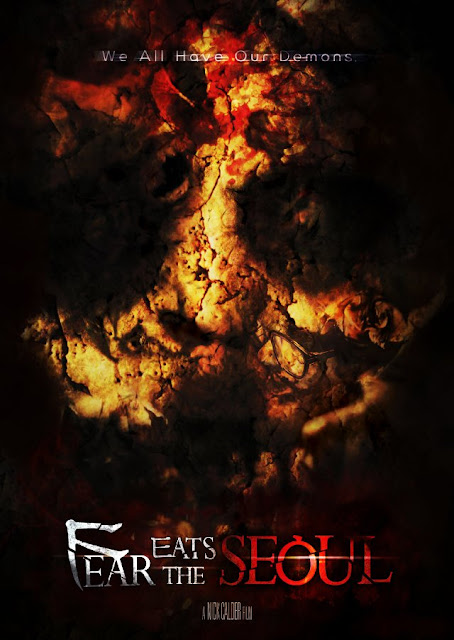
This pun is pretty good. Like a prior entry, it reads "the Seoul" instead of "Seoul", suggesting that nobody thought very hard how to shoe-horn this pun together. However, it's more clearly referring to Fassbinder's "Ali: Fear Eats the Soul". The possibly pretentious character of the reference is soothed by the badness of the pun, which means that the pun is in service to the work and not a stupid afterthought. This is rare enough that it should be encouraged. Also, little puns run throughout the title, with the F in fear laid out as a backward ㅋ and the o in Seoul as a ㅇ that the concept appears, after consideration, to be clearly thought through.


This is a terrible resonance. Not only does it avoid using Seoul to any useful effect, it is in the midst of a grammatical nightmare, as if the nomad found her soul in Seoul while living my designer life. The cover is vaguely asian, enough to be offensive but not informative, making it more clear how little the Seoul is relevant to the story except as an "other than where you are place". The rustic character suggests that the author is either going to lie about what life in a massive modern city is like or hasn't herself been there, or is posturing as some world-weary traveler who has been living the easy life of a Korean expatriate. Useless and offensive.


This pun is bad. The show seems based on the badness of the pun, as there are many more common Army hospitals for children to be born and also this is not a problem at all for anyone, also there is homophobia in it, anyway, the show is bad and the pun is bad because it is the source of the dumb plot of the show. 


This resonance is not very good. It is less bad than the other resonances of "Soul in Seoul", partly because it doesn't overtly distance the two concepts as if Seoul was an unnatural place for a soul to be. However, the Korean title, "나의 영혼인 서울" gives the impression that it is an accident of translation that it has this terrible name, which seems misleading when the english title is clearly prior. It could have been better titled than this, but the resonance is merely flat.


This pun is bad. The original to which the pun refers, the Beatles album 'Rubber Soul', is already joke on the "plastic soul" concept of white musicians singing delta blues. This pun doesn't carry through, which means the reference is treated as an object-corm, undifferentiated and unlayered. This appears as part of an AIDS awareness campaign, but it feels like the pun was sitting on a shelf for decades until someone finally found the appropriate use, rather than some creative AIDS activists were discussing how to market their event and happened on the idea. The staleness and the estrangement of the reference make it a bad pun. 


This pun is not a good pun. Seoul Eater would be a funny pun if it was used correctly, and I was disappointed that there was no good "Seoul Eater". In this instance, it's not even a real graffito, which is irritating, and Kim Jong Il portrayed this way perpetuates racism about east Asian cannibalism and the lettering is reminiscent of US military stencils, so it just makes you sick to your stomach before you even read the pun. Supposing it was written before the death of Kim Jong Il, is badly improphetic as Kim maintained the wary truce between the two countries for more than three decades. The pun itself isn't enough to overcome the foolishness and grossness, because it doesn't try to move anywhere beyond "Kim Jong Il is a kind of devil or demon".


This is two bad puns simultaneously. "Seoul Mate" is an acquaintance or friend in Seoul, while "Soul Mate" is one with whom your essence copulates. The "Seoul" of the first implies that the mate could never be a "Soul" mate but a mate tied to a particular place. Like many of these puns, it uses the location "Seoul" to psychologically distance and project from itself, in order to retroactively insist that it did not intend to fail at finding intense love in Seoul, but that such a failing was the whole plan. 


This is an only barely okay pun. Unlike the prior, it emphasizes the togetherness of the concept and uses signifiers of traditional Korean life to locate itself somewhere besides the abstract. All the potential agents are engaged actively, and are identified as "Korea" and through the statement, with "Seoul", so they do not appear to engage with the culture as a casual thing to be discarded. Despite these, it is playfulness of the "Soul mate" concept as used here, undermining its seriousness by putting it on two young kids. Actually, tho that's true, it stretches the nature of the pun too far, so not being offensive, it emphasizes how contingent and unnecessary the "seoul as soul" is; this could be "Masan Mates" or "Jeolla Mates", so no, this is not a good pun.


This pun is bad. Again, the pun displaces the love the person might have felt in Seoul, onto Seoul, in order to equally resist the possibility that the failure of that love was on the person who failed, namely the author. The melodramatic hands are dumb as well, and subtitle: "Tears and Tragedy" who could want to read a book of this kind. 


This is a bad pun. Seoul has soul music, so it is conceivable to advertise "Seoul Soul Music", there isn't a need to cross out soul. At the same time, "Seoul Music" is not the clear genre distinction that "soul music" is, because all Korean music is effectively "Seoul Music". It is uninformative. Were it a more fully accomplished pun, it might have taken something to do with the inversion of hierarchies of experience that declared "soul music" the music of the heart and everything else an inauthenticity, but there doesn't seem here to be a consideration of authenticities either.


This is a good pun. It is purely superficial, two-sided; the Seoul is material and on fire is material, the Soul is immaterial and the on fire is metaphorical; the kind of symmetry appears to be accidental or unpracticed but I hope the other images in this collection confirm how difficult it is to write a pure, meaningless set of three words without drifting into nonsense or racism. Exciting looking book, I am curious about what the inner struggle of its protagonist might be. 


Amazing pun. Not merely a reference to the Eldridge Cleaver autobiography, it connects deeply with the roots of the Black Panther party to their Vietnam service. In this case, the fantasy is the backward projection of black radicalism, to the veterans of WWII and Korea, and the international struggle against faceless white supremacy and imperialism. The concrete identification of the black panthers with their "comrads of the east" not only erases the distance potentially between the Soul and the othered Seoul, the design and nature of the image make it appear as if Seoul is to be the remedy for the Ice, of all people of color prevented from essential agency by the white supremacist and fascist cause. This is the best "seoul / soul" pun.


This pun is bad and gross. Like earlier bad puns, it unwittingly takes its pun from an earlier pun or reference, as if the earlier pun or reference was complete and without further reference. In this case, the Soul of Soul Patch is a musical reference, effectively identical to "Seoul Music" but applied to a restaurant. Further, it associates facial hair with food. Finally, and embarrassingly, the gross facial hair that it associates with Seoul was worn most famously, in the recent period, by Apolo Ohno, whose rude tricks and cheating schemes against Korean speed-skaters make his name dirt in the Seoul suggested by the sign. 


This is an alright pun. While it seems like the reaper is indeterminate; does it reap in Seoul, does it reap Souls, or does it reap Seoul-Souls, it is a pun that moves between the name of its creator, Jay SeOul and the concept of Soul-reaping, with the meaning of Seoul city, South Korea fading into the background.


This pun is not very good. It relates the character of introspection to the practice of contemporary Korean cinema, as if current filmmakers were finally discovering who they, as Koreans, might be or are becoming. The pun, like so many, allows the homonymy to distance the natural understanding of cinema into a place where they are more authentically introspective, but a less appropriate place would be hard to imagine. Much contemporary Korean cinema has roots and effects in radical social realism and not the psychological content, particularly not the abstract and de-tethered content suggested by the title. At the same time, the other meaning of "soul searching", related to the practice of auto-critique before a confession of sin, is similarly inaccurate as the social critique in contemporary Korean cinema is better described as the vengeful accusation of the long suppressed rather than the confession of the formerly dictatorial powers. Lastly, most Korean films are produced in Busan, so the "soul" that is being searched, the hidden essence of directorial agency, is not even in Seoul.


This pun is very good. Seoul Stirring and Soul Stirring can be read as nearly identical in certain popular arts, as they occur in Seoul, and most identical in something like Cinema. The pun doesn't waste itself with a reference, but allows the growth of contemporary Korean culture to be portrayed as a mutual-project; the more the artists rise, the more the people rise, and the more the artists rise from the people. This is hinted at by the stylized "e" in Seoul. 


Bad, borderline sociopathic pun. Ben Johnson narcissistically uses "Seoul" as a metonym for the 1988 Seoul Olympics and the 1988 Seoul Olympics as a metonym for his getting caught using steroids after breaking the 100m record there. This turns Seoul into the dark negative from which the positive, Soul, blossoms.


This pun is pretty good. Reversing Johnson's logic, we see the comparison isn't between a strange other and a true self, but one self and many others. That is, the progression of the individual soul to engage in the broader collectivity of Seoul city, becoming as it always was a part of this tremendously large yet hyperlocal object. Soul to Seoul, with the image of this youth, allows us to see the shedding of the old-fashioned essential individualist assumptions, joining with Seoul, the existing real thing.


This is a bad pun. Soul train, in the context of the original show, played on the word "tracks" and the determinisms of dance music, that one was being carried through the music by its nature. "Seoul Train" obviously lacks any metaphorical depth, but all the other images and text suggest something very serious, as if it might be about a train in Seoul and unaware of the television show. It isn't about a train in Seoul, however, but about North Korean defectors who travel by train in China avoiding recapture on their way to South Korea. If the documentary wanted to emphasize the desperate nature of the travel, "Train of Souls" would have done it, and made more clear to them that "Train of Seouls" sounds insane and is a bad pun in a place unworthy of wordplay.


This pun is pretty bad. Unlike the former, which lacked a reference to Seoul outside of "the korean peninsula", this image resorts to a misshaped Korean flag to let us know there might be a sense to this pun. The pun itself is written on a chalkboard, perhaps we know now this is about expatriate foreign teacher drunken recklessness, etc., but it doesn't have anything to do with trains and we're left with another sense lining out away from coherent meaning. The problem seems to be that the writer is operating on a rebus level; "teacher train british (-> mulcahey) in korea (-> Seoul) drunk" while the pun is only in order to provide the rebus a more concrete interpretation for the Korean flag. Seoul Life or A Man in Seoul or What Happened in Seoul are each adequate to the meaning intended, and Seoul Train just seems tacked on and strange.


This is a collection of some tv shows that also have Seoul puns in them. These are mostly bad, but two things stand out.
1) "Seoul Food" is a horrible pun. First, the "Soul" pronunciation of "Seoul" has its own meaning, "Seol food" could be food from the Seol Holiday. Second, this would be the opportunity to use "Seoul Eater" properly, but it wasn't done and nobody has done it, and that remains a shame. 
2) These are mostly racist, identifying a Korean guest character by naming the show after the capital of that actor's home or ancestral nation. 


This pun is good, I think, because the hyphen fractures it into two simultaneous puns. "Soulful Letters" to "Seoulful Letters", letters both emotional and emotional in a way particular to Seoul, and "Soul-Full Letters" to "Seoul-Full Letters", letters whose content is full of one's innermost thoughts and soul and also is full of Seoul information and happenings. It draws attention, too, to the indeterminacy of the word "soulful" to begin with, as well as allowing Seoul into the emotional life, the obviously but strangely unused essence of Seoul / Soul.


This pun is really good. What appears obvious, "Soulless Night" to "Seouless Night" suddenly seems strange, what is a "Soulless night"? Ah! Then it occurs to us, this is a three stage pun, from Sleepless Night to Soulless Night to Seouless Night. The darkness of the earth on the cover, the indication of geopolitical menace and the threat to one of the world's great cities, for which absence would represent a soulless act, the anxiety and fear that creates as a nation suffers near this stable instability, this unmarked threat, this is a tripartite pun and functions at each point appropriately.
It is even better than it seems, for resisting the urge to write Seoulless Night, which might be more accurate but is ugly to look at, the titler of this book is thinking with his aesthetics and it shows. 


This pun is bad. A letter might be full of Seoul, a night might be Seoul-absent, but what is Seoul doing in a kiss? The interesting notion that a kiss might be produced by Seoul itself, that the humongous mechanism could, at a single point, release into a blossom of love that would have occurred nowhere, nohow else, is erased by the kiss itself being full of, instead of "ensoulled" a better resource for a pun and another that was unseen by my research.


This is a bad pun but a very good cover. It is a nihilistic reproach to the rebus style cover of "Seoul Train", where none of the elements refer to each other. First, "Sunflower Seeds and Seoul Food" almost seems like there isn't a pun at all, a sign of a bad pun, but then you wouldn't name a book "Sunflower Seeds and Soul Food" either. The name has no information except probably white, probably not Korean. The photo is of newsprint with a whistle on it, but newspapers are inert, you cannot interact with them and you don't need to. The only people who wear whistles are referees or coaches, but they don't usually wear them to read the newspapers. Then the bottom, "On Sports" but in quotation marks, I think this predates the rise of irony-suggesting inverted commas, but the quotation marks then indicate what, that this is spoken? To a newspaper? That despite the title, sports is the emphasis? Lastly, "featured in THE WALL STREET JOURNAL", the wall street journal's logo is a logo and not a name, and "featured in" is something that advertised products that have bought ad space in a magazine will say, so perhaps it is a sports columnist whose column is called "on sports" tho the whistle is still very incorrect, or perhaps it is something incredibly else.


This is not a good pun. It leaves a hanging foot. Troubled soul, troubled is most probably an adjective, so the soul is in conflict or motion. Troubled Seoul, troubled is most probably a past tense verb, Seoul is being troubled, but this title lacks an agent. That's pretty interesting, as if a gap or a silence is the trouble in Seoul, but the man is getting into a clipart plane, so the gap is filled, the author just didn't indicate it and left us with only the first pun. If I gave Fear Eats the Soul some credit for the little jokes in its design, then I should also be mad at this ugly cover for the OU // OU and L // L issues and the phonics of "Troubled soul" which are so garbled and unpleasant that the author should have chosen a different word entirely to make his bad pun with.


11.2.13

Pope


2.12.12

THE GONJIAM INSANE ASYLUM IS FULL OF GHOSTS

Gonjiam Proper Ominous Tree on the way to the haunted asylum Walk up spooky path Climbing the walls! So scary They've welded the bed springs over the doors Sunset in the mad kingdom Graffito scratched in the cement with fingernails perhaps This hall is full of potential ghosts

Here's a video of me going into the kitchen: The mud-covered kitchen Graffito Turn off the fucking light screamed the ghost One object been put on the wall, to compensate, for the other object being removed Passageway for ghost's food EAT EAT EAT WITH US they scream Dangling spooky cord, probably plugs into hell ghostly scattered dishes Some metal bits Tina behind a welded-on bed How to leave a haunted asylum, through the graveyard